The Milky Way vs. Light Pollution: The Bortle Scale Explained
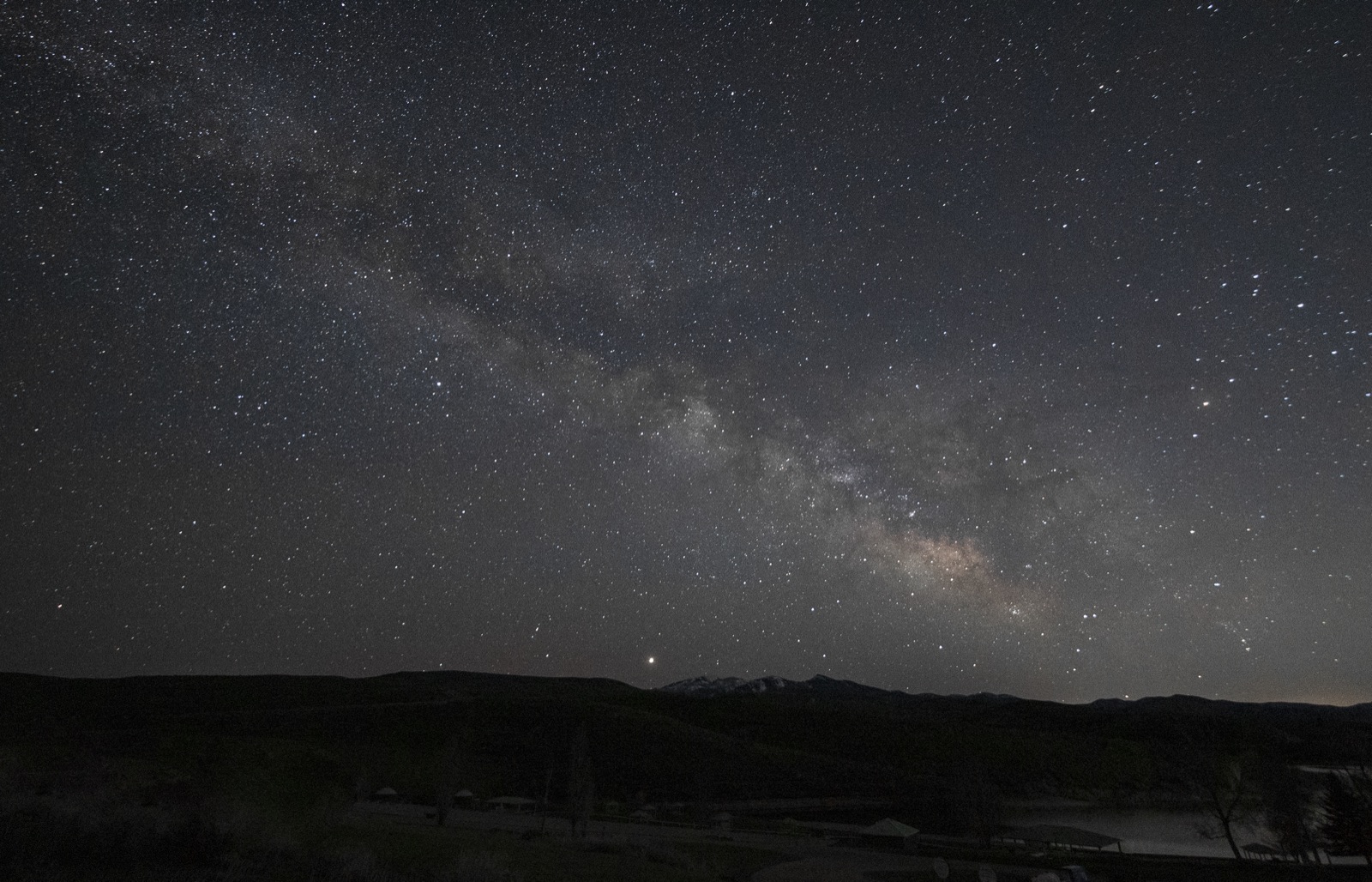
Astronomers rate night skies on a 9-level scale. Most Americans live at level 7 to 9, where the Milky Way does not exist. Bryce Canyon sits at level 1 to 2. Here is what every level actually hides — and what comes back when nothing is hidden.
What the Bortle scale measures
In 2001, amateur astronomer John Bortle published a 9-class scale in Sky & Telescope that describes how dark a night sky is, based on what a careful observer can and cannot see. Class 1 is the darkest sky on Earth; Class 9 is an inner-city sky. It is the standard shorthand stargazers use because it translates abstract brightness measurements into a simple question: what disappears?
Light pollution works by raising the brightness of the sky background. Stars and the Milky Way do not get dimmer — the sky behind them gets brighter, and low-contrast objects sink below the noise. Diffuse glow like the Milky Way is always the first casualty, which is why satellite-based studies estimate roughly 80 percent of North Americans can no longer see it from home.
The scale, level by level
| Class | Typical location | What you see — and what you lose |
|---|---|---|
| 1 | Remotest dark-sky sites | Milky Way casts faint shadows; zodiacal light obvious; limiting magnitude ~7.6–8.0. Airglow visible. Nothing is hidden. |
| 2 | Truly dark rural areas | Milky Way richly structured; clouds appear as black holes in the sky; limiting magnitude ~7.1–7.5. |
| 3 | Rural sky | Milky Way still complex; some light domes on the horizon; limiting magnitude ~6.6–7.0. |
| 4 | Rural/suburban transition | Milky Way visible but loses fine structure; light domes obvious in several directions. |
| 5 | Suburban sky | Milky Way weak or washed out near the horizon, visible only overhead on the best nights. |
| 6 | Bright suburban sky | Milky Way only hinted at near the zenith; sky glows grayish white at the horizon. |
| 7 | Suburban/urban transition | Milky Way invisible. Sky a uniform grayish glow; only bright stars and planets remain. |
| 8 | City sky | Sky glows orange or white; you can read by it. A few dozen stars visible. |
| 9 | Inner city | Only the moon, planets, and a handful of the brightest stars survive. |
Most Americans live between Class 7 and Class 9. The entire experience this site describes — the band, the dark rifts, the star clouds — happens in the part of the scale the majority of people have never visited.
Experience the top of the scale
A guided night at Bryce is a tour of everything Classes 7–9 erase — with telescopes, dark-adapted eyes, and someone to point at it all.
Book a Dark-Sky Tour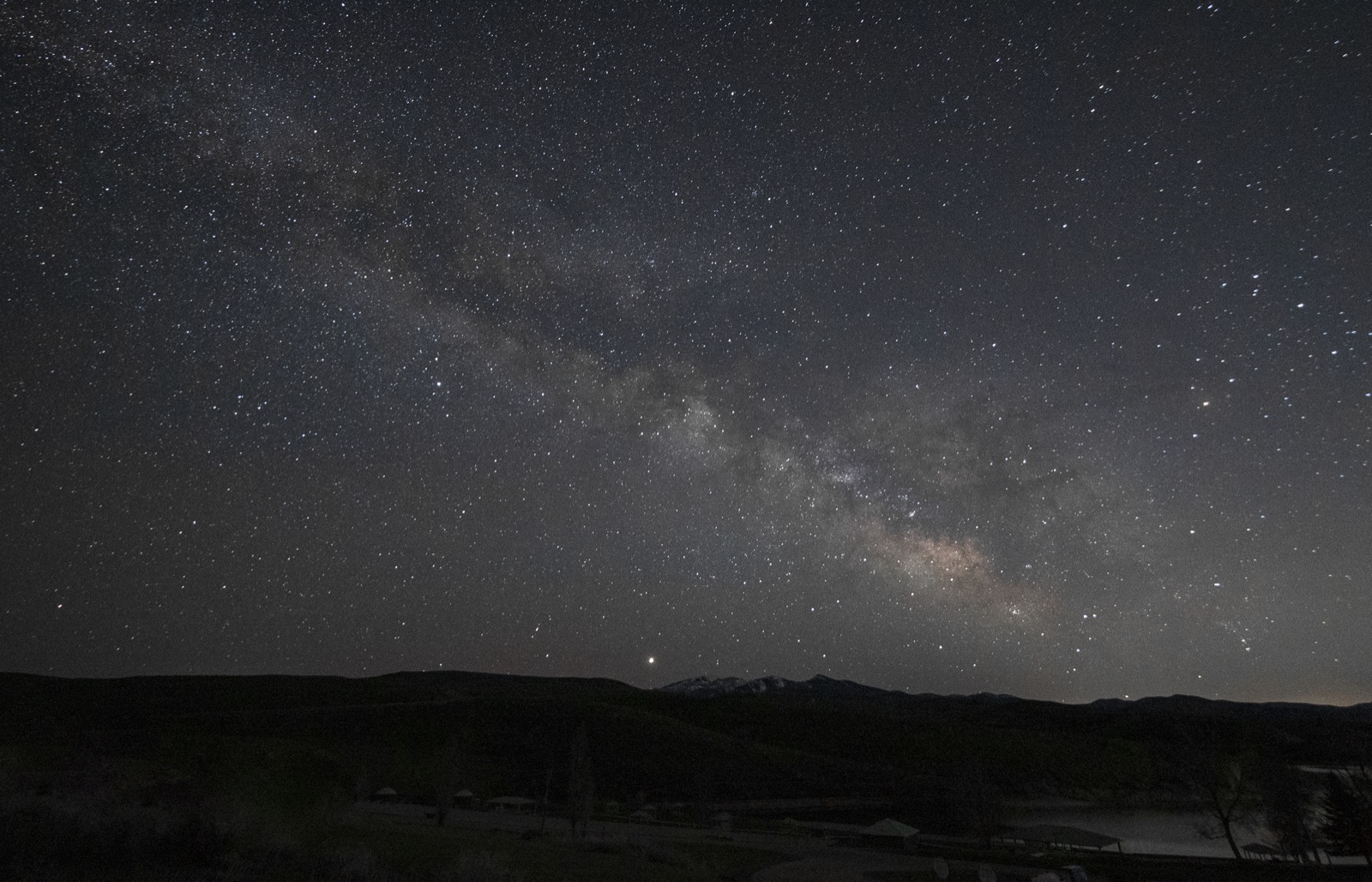
Where Bryce Canyon sits, and why
Bryce Canyon rates Bortle 1 to 2, with measured limiting magnitudes around 7.4 on the best moonless nights. That number was a key part of its 2019 certification as an International Dark Sky Park. Three factors stack in its favor:
- Geography. The nearest large metropolitan areas are roughly four hours away. Look at any light pollution map of the lower 48 and southern Utah is the biggest contiguous pool of black on it — Bryce sits inside it, surrounded by other protected dark areas rather than by towns.
- Elevation. At 8,000–9,100 feet, you stand above a meaningful fraction of the atmosphere’s haze, water vapor, and aerosols. Stars scintillate less and faint detail holds closer to the horizon — exactly where the galactic core lives.
- Stewardship. The park and its neighbors manage outdoor lighting deliberately: shielded, warm-toned, minimal. Dark-sky certification is an ongoing commitment, not a one-time plaque.
The practical difference between a Class 4 sky and a Class 1–2 sky is hard to overstate. At Class 4 you would say “yes, I can see the Milky Way.” At Bryce, the question reverses: the Milky Way is the brightest structure in the sky, and you find yourself asking what all the other glowing things are. (Often: zodiacal light, airglow, and the Andromeda galaxy with your naked eye.)
Reading a light pollution map before your trip
Free light pollution maps (search “light pollution map”) color-code the world from white (worst) through red, orange, yellow, green, and blue to gray/black (best). Two tips for using them:
- Check your own address first. Knowing your home sky is, say, orange (Bortle 6–7) calibrates what the black zone around Bryce will mean for your eyes.
- Look at the horizon, not just the spot. A dark pin with a city glow 30 miles south will wash out the low southern sky where the core sits. Bryce’s southern horizon faces the Grand Staircase — protected, nearly unpopulated land for a very long way.
One caveat the maps cannot show: the moon. A full moon turns even a Bortle 1 site into the equivalent of a bright suburb for the night. Plan dates with the moon phase guide and aim for the core season.
What this means for your night at the rim
Under a Class 1–2 sky, your own habits become the limiting factor. Full dark adaptation takes 20–30 minutes and a single glance at a white phone screen resets much of it — use red light only. Stand somewhere with an open southern horizon (the viewpoint guide lists the best), and give yourself at least an hour; the sky genuinely improves the longer you are out. If you want to bring home proof, even a phone can capture the band here — the photography guide shows how.
See what 80 percent of the country can’t
Bryce Canyon Stargazing runs guided nights under some of the darkest measured skies in the United States, throughout Milky Way season.
Check Tour Availability