Milky Way Season in Utah: The Month-by-Month Guide
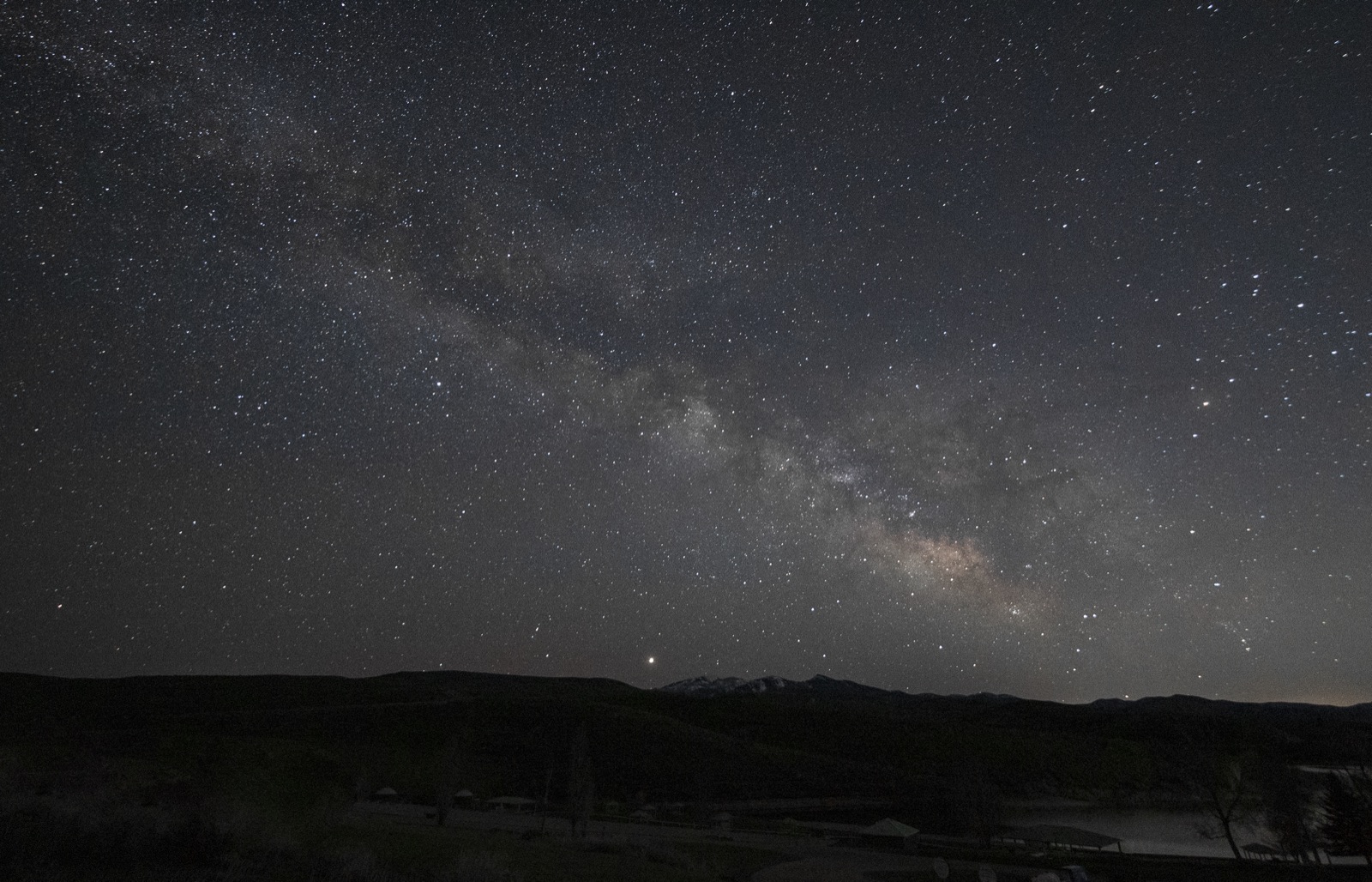
The galactic core is visible from southern Utah from roughly February through October, but the experience changes dramatically by month. Here is exactly what to expect, and why June through August evenings are the sweet spot at Bryce Canyon.
First, what “Milky Way season” actually means
Some part of the Milky Way is overhead every clear night of the year — our solar system sits inside the galaxy, so its disk always crosses the sky somewhere. When people say “Milky Way season,” they mean the months when the galactic core is above the horizon at night. The core, in the direction of the constellation Sagittarius, is the brightest, most structured, most photogenic stretch of the band — the part that produces the classic glowing-arch images.
Because Earth orbits the sun, the core’s position relative to our night side shifts about two hours earlier each month. In November through January it is up during daylight (hidden behind the sun), and from February it begins re-emerging into the pre-dawn sky, drifting earlier and earlier until by October it sets shortly after dusk.
Core visibility by month at Bryce Canyon
Bryce Canyon sits near 37.6°N latitude. The table below gives approximate local-time patterns for when the core region clears the horizon and when it is best placed. Exact times shift through each month and with twilight length.
| Month | Core appears | Best viewing window | Notes |
|---|---|---|---|
| February | ~4–5 a.m. | Hour before dawn | Low in the southeast; cold pre-dawn sessions only |
| March | ~2–3 a.m. | 3 a.m. to dawn | Season opener for photographers |
| April | ~midnight–1 a.m. | 1–4 a.m. | Full arch rises before dawn; still very cold at 8,000 ft |
| May | ~10–11 p.m. | 11 p.m.–3 a.m. | First comfortable evening-adjacent viewing |
| June | ~9–10 p.m. | 10:30 p.m.–2 a.m. | Core up by end of twilight; peak season begins |
| July | Already up at dark | 10 p.m.–2 a.m. | Core highest in the south mid-evening; warmest nights |
| August | Already up at dark | 9:30 p.m.–1 a.m. | Excellent evening viewing; watch for monsoon clouds |
| September | Already up at dark | 8:30 p.m.–midnight | Core in the south-southwest at dusk, sets around midnight |
| October | Low in SW at dusk | First 1–2 hours of darkness | Last call; core sets early but evenings start early too |
| Nov–Jan | Not visible | — | Core is behind the sun; winter band still visible |
All times are approximate Mountain Time patterns for mid-month. The core also gains altitude through the night early in the season and loses it late in the season — a guide or planetarium app will pin down your exact night.
Skip the math — tour nights are scheduled around the sky
Bryce Canyon Stargazing plans its guided tours around core position, twilight, and moonrise, so the night you book is a night the sky can deliver.
See Tour Dates
Why June through August evenings are peak
Three things line up in midsummer that do not line up any other time of year:
- The core is up at a civilized hour. From June onward, the core is above the horizon by the time astronomical twilight ends. No 3 a.m. alarm — you can watch the galaxy rise over the hoodoos before midnight.
- The core reaches its highest point in the sky. From 37.6°N, the core culminates roughly 20–25 degrees above the southern horizon. In midsummer that culmination happens during prime evening hours, lifting the brightest star clouds well clear of horizon haze.
- Nights are warmest. “Warm” is relative at 8,000+ feet — expect 40s and 50s Fahrenheit even in July — but it beats the sub-freezing pre-dawn sessions of March and April.
The midsummer trade-offs are honest ones: nights are shortest (true darkness may not begin until after 10 p.m. in June), and the July–August monsoon can build afternoon thunderstorms. Monsoon storms usually collapse after sunset, often leaving washed, exceptionally transparent air — but check the forecast.
Shoulder seasons: the underrated months
April and May
The core rises late but the air is steady and crowds are thin. May is the first month where a normal traveler — not just a dedicated photographer — can stay up to see the core without staying up all night. Pack genuinely warm layers.
September and October
Arguably the smartest booking of the year. The core is already up when darkness falls, evenings start early, summer crowds are gone, and the monsoon has usually ended. By October the core is low and sets quickly, so plan for the first hour or two of darkness and treat it as a sunset-into-stars evening.
The calendar is only half the plan
A perfect July night with a full moon will show you almost no Milky Way; moonlight at Bryce is bright enough to read by. Once you have a month in mind, choose dates using the moon phase planning guide — it includes the 2026 new moon dates. Then pick your viewpoint from the where-to-see-it guide, and if you want to capture it, the photography guide covers settings for phones and cameras. Quick answers live in the FAQ.
Pick your season, then book the night
Guided tours run through the May–September prime window and beyond. Choose a date near a new moon for the full magnitude 7.4 experience.
Book a Stargazing Tour